
by Zenny K. Sadlon
It was during a late-stage editorial reflection, forty pages from the end of the unfinished fourth book of The Fateful Adventures of the Good Soldier Švejk, that I arrived at a striking insight. The novel, long interpreted as a satire, an antiwar tract, or a study in ambiguity, revealed itself under the pressure of translation as something more architecturally deliberate: a trial.
This insight emerged not through theory but through friction. In reviewing a paragraph in which the General condemns Švejk in Czech as both an "idiot"(idiot) and, moments later, a "blbec"(imbecile), I became briefly uncertain. Was the second term a mistranslation of "blbec"? Was “imbecile” too close to the earlier “idiot”? Or was something deeper happening?
The answer, rooted in Czech nuance and Hašek’s rhetorical layering, was that the pairing was intentional. Hašek had not simply repeated himself but shifted register. He began with the clinical or institutional term “idiot”, then pivoted to “imbecile”, a Czech vernacular insult.
In English, "idiot" and "imbecile" may appear synonymous, especially in their colloquial first senses as simple insults or labels for foolishness. But their histories and connotations diverge. “Idiot”, though used broadly today, retains a faint trace of its formal medical past, denoting extreme intellectual disability. “Imbecile” originally occupied a milder, intermediate diagnostic category, moderate intellectual disability, and likewise drifted into general insult.[i][ii] Both are now considered offensive in clinical contexts, but the difference remains visible in their tone and cultural load. In English, that difference is residual, a matter of connotation. In Czech, it is structural, a drop in register that does narrative work. Their interplay marks a tonal descent, from judgment to ridicule, from diagnosis to mockery.
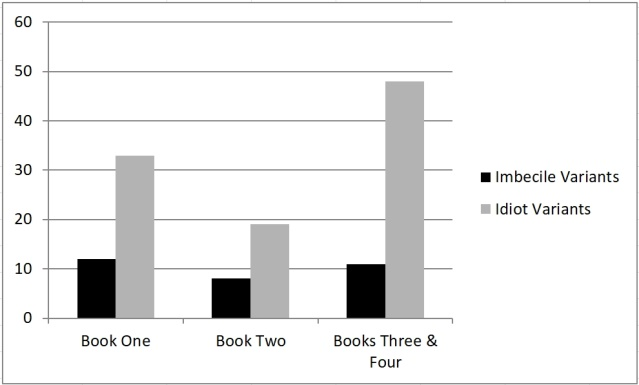
This diagnostic language is not incidental. It recurs with such frequency, intensity, and variety across the four books that it takes on the character of a sustained prosecutorial record. The terms "idiot" and "imbecile", along with their adjectival and nominal derivatives, function as markers of accusation, classification, and ultimately, narrative control. In total, these terms appear 131 times in the novel: 100 instances of "idiot" variants (including idiocy, idiotic, idiotically) and 31 instances of "imbecile" (including one “imbecility”). But what matters more than the totals is how and to whom they are applied.
Another striking instance of this diagnostic lexicon occurs at the very threshold of Book Three, where Hašek repeats the intensifier “to the squared power” three times in quick succession. Švejk first calls Field Chaplain Ibl’s bombastic sermon “stupidity to the squared power,” then repeats it when recalling the same story later the same day, and finally lets the phrase drop into “an imbecile to the squared power”. Here, the movement is again one of tonal descent: from the abstract condition of “stupidity” to the direct branding of a person as an “imbecile.” The numerical trope of squaring is grotesquely misapplied, turning language of measurement into language of ridicule. Its very repetition enacts the absurdity of quantifying human capacity, just as the earlier grotesque ratio of “forty-eight men or eight horses” reduced human life to arithmetic. By hammering the phrase three times, Hašek sets the second half of the novel under the sign of compounded idiocy; not as diagnosis, but as of diagnosis.
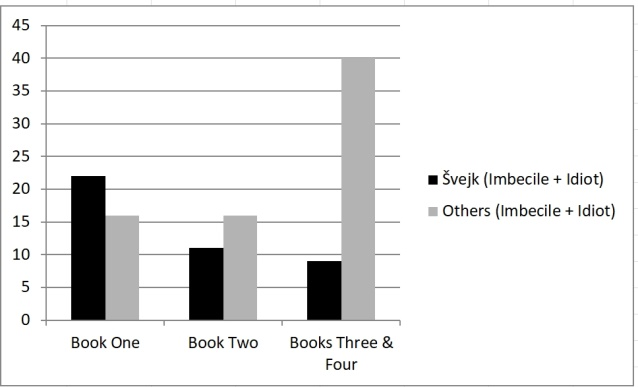
In the first half of the novel, especially Book One, the weight of this diagnostic vocabulary falls squarely on Švejk himself. He is officially proclaimed an "imbecile" by medical and military authorities, referred to repeatedly as a "notorious idiot", and described in accumulating epithets that blur the line between comic exaggeration and clinical judgment. Of the 42 instances across the novel where these terms are applied to Švejk, more than half occur in Book One. This is the prosecutorial opening argument: a caricature of idiocy presented as evidence, with official reports, medical examinations, and verbal abuse all piling on to establish the defendant's supposed mental incompetence, or more precisely, his criminal cunning masked as incompetence. The reader is placed in the position of a tribunal being asked to evaluate not only Švejk’s behavior, but his very nature.
Yet the pattern does not remain fixed. As the novel progresses, the prosecution’s vocabulary is increasingly turned outward, repurposed to indict others. In Book One, 22 of the total 42 uses of idiot or imbecile are directed at Švejk. But in Books Three and Four, the majority of "idiot" and "imbecile" labels no longer refer to Švejk, but to his superiors: officers, judges, colonels, medical examiners, bureaucrats. Some instances even target abstract structures, such as the "idiotic monarchy" or the "idiotic history of mankind". In raw numbers, 72 of the 131 total uses, more than half, are applied to figures other than Švejk, and this proportion only grows in the later books: in Book Four, for example, nearly three-quarters of such references shift away from him. By the time we reach the final act, Švejk is no longer merely the object of the trial. He has become, in effect, its silent cross-examiner, an "idiot" so notorious that he becomes the baseline against which all other idiocy is measured.[iii][iv]
This rhetorical reversal is one of Hašek’s most brilliant maneuvers. The language that once condemned Švejk now becomes the instrument of a broader satire. The reader, originally positioned to judge Švejk, is gradually led to question the legitimacy of the courtroom itself. The repeated labeling of others as "idiots", "imbeciles", or "morons" begins to undermine the coherence of the prosecution. What had appeared as psychiatric or military classification reveals itself as farce, and the accused, still absurd, becomes more credible than his judges.
In this sense, the diagnostic lexicon operates as a narrative diagnostic as well1. It tracks the novel’s structural swing between accusation and testimony, between caricature and credibility. The shift in its application, from Švejk to others, from individual to system, mirrors the arc of a trial that has lost control of its own logic. The prosecution overreaches. The categories collapse. And so the reader, like a member of the jury, finds himself re-evaluating not the sanity of the accused, but the sanity of those who presume to judge him.
It was my resistance to repeated AI-generated suggestions of "fool", "moron", "blockhead" that preserved the original phrasing. The AI, acting from pattern recognition, repeatedly flagged the repetition or argued for variation. But my insistence on Hašek’s rhythm and register, on fidelity not only to meaning but to the sociolinguistic movement of the sentence, held firm. That fidelity triggered a realization: the entire novel mirrors the logic of trial proceedings.
In my rendering, the General’s words unfold with tonal descent:
“That man is an utter idiot,” said the General to the Major. “To be changing on the dam of a pond into some Russian uniform, left there by God knows whom, to let oneself be mustered with a party of Russian prisoners of war, that can do only an imbecile.”
By contrast, in Cecil Parrott’s 1973 translation, the same passage is rendered:
“The fellow is a complete imbecile,” said the general to the major. “Only a bloody idiot would put on a Russian uniform left on the dam of a lake by goodness knows whom and then get himself drafted into a party of Russian prisoners.”[v]
Note: In the Czech, the words “idiot” and “imbecile” stand at opposite ends of the general’s outburst, forming rhetorical brackets that frame the passage. This translation preserves that spacing, following Hašek’s original rhythm. Parrott’s compression of both terms into the opening of the passage collapses the structural escalation—one of the “hundred nothings that had worn out the ox to death,” as Czechs say.
Parrott smooths the Czech into natural English rhythm and idiom, not only sacrificing, but reversing the shift in register from Hašek’s “idiot” to “blbec”. What appears as redundancy in English is, in Czech, tonal movement, a descent that Parrott inverts into a heightening. On top of this, he inserts “bloody,” a favorite intensifier of his, scattered throughout his version. The result is not Hašek’s clinical-to-vernacular descent, but a distortion doubled: the reversed register reinforced by the intrusive flourish of “bloody.” As I noted in my response to Michelle Woods in the Jacket magazine, the adjective “bloody” is used and misused in his version incredibly too often, to the point that he once added “bloody ass” in front of “such as Lieutenant Dub” just for good measure.
It was precisely this friction that sparked my recognition of a prosecutorial logic embedded in the novel’s form.
The opening paragraph of Švejk announces the charge: “when a military medical commission had pronounced him definitely to be an imbecile.” From that moment forward, every encounter in the book functions as a kind of testimony, sometimes for the prosecution, sometimes for the defense. Authorities, doctors, officers, priests, and common folk each weigh in. Some ridicule Švejk, others admire him, and a few waver. The novel proceeds like a pendulum, swinging between condemnation and exoneration, incompetence and cunning, obedience and provocation.
Far from a monolithic character, Švejk becomes a site of argument. His declarations, jokes, digressions, and apparent naiveté operate not to assert identity, but to confuse, deflect, or expose the absurdity of those in power. And like a trial, the reader is never told the final verdict, at least, not until the end of the process. Unfortunately, Jaroslav Hašek passed away before completing his work, before presenting all the arguments for both the prosecution and the defense. And so the reader, like this translator, and like the critic, is left to play judge, jury, and executioner. The ambiguity is the method.
This reframing casts new light on the novel’s structure. What seemed meandering now appears dialectical. What once read as episodic delay now becomes procedural layering. Each scene becomes a deposition, each officer a witness, each diagnosis a renewed iteration of the charge. Švejk is being tried, not by the state alone, but by the narrative itself. The State attempts to try Švejk through institutional procedure, while the narrative subjects him to a continuous trial of public opinion, constituted by the accumulated judgments of those who encounter him.
This insight also reframes critical debates around the novel. Scholars such as Michelle Woods have focused on whether Švejk is a "fool or a provocateur", noting that ambiguity is central to Hašek’s method. But this dichotomy may be too narrow. In my response to her in 2010, I stated: “The novel is a virtual reality and the character of Josef Švejk is the port through which the reader gets there.” The question is not whether Švejk "is" one thing or another. It is whether the system, in all its irrational bureaucracy and violent discipline, is capable of producing, through processes of diagnosis, documentation, and control, a legible human subject: measurable, categorizable, and controllable.
In this light, The Fateful Adventures of the Good Soldier Švejk is not just a novel about surviving war. It is a trial transcript, one in which the defense is conducted not with arguments, but with digressions, idioms, jokes, repetitions, mimicry, and studied compliance. Hašek’s genius lies in building a satire whose very form mirrors the absurd logic it condemns.
And it was my ear, attuned to the difference between "idiot" and "blbec", that uncovered it.
Appendix:
On the Distinction between "Idiot" and "Blbec"
The word "idiot" in Czech is a loanword from Greek (“idiōtēs”, meaning private or layperson), which passed through Latin and French before being medicalized and pejorativized. It came to designate someone with severe intellectual disability, and later, by metaphorical extension, a person of subnormal intelligence or behavior. It carries an institutional, clinical, or formal tone, even when used insultingly. It is, in Czech, a diagnosis before it is an insult.[vi]
In contrast, "blbec" is a native Czech derivation from "blbý"(stupid), itself rooted in onomatopoeic origins: the sound “blb-blb”, a babbling, stumbling idiocy of speech. It is vernacular, informal, and deeply Czech. Far from clinical, it belongs to the language of pubs, soldiers, and common speech. It is what someone might mutter about a driver on the street or a friend after a foolish remark. "Blbec" belongs to the realm of everyday moral judgment, not medical designation.[vii]
Modern usage confirms this distinction. Dictionaries like Wikislovník define "idiot" as “velmi hloupý člověk” (a very stupid person), with additional notes on its offensiveness and clinical heritage. The entry for "blbec", on the other hand, adds colloquiality, mildness, and frequency in humorous idioms, for example “náhoda je blbec” (“coincidence is an imbecile”).[viii][ix]
Resources like Nechybujte.cz warn that “idiot” carries stronger connotations, while “blbec” is used in speech to label a fool, not a case. It is a cultural insult, not a psychological classification.[x][xi]
The public-facing language advisory portals distinguish the words in both semantic load and emotional valence: idiot stings; imbecile shrugs; idiot condemns; imbecile belittles.
This is not a trivial distinction. In Czech, where register is performative, the movement from "idiot" to "blbec" is a tonal descent, from formal denouncement to social mockery. Hašek knew this.
Hašek begins the paragraph with a formal declaration, “That man is an utter idiot,” and ends it with a vernacular judgment: “...that can do only an imbecile.” The shift is not redundancy. It is escalation by descent, from diagnosis to derision. The English sentence can seem repetitive without this understanding. But my fidelity to Hašek’s Czech exposed a rhetorical movement missed in Parrott’s translation, where tonal descent is inverted into intensification.
And from that insight, the friction between fidelity and flattening, between "idiot" and "blbec", emerged the greater structure: the novel as a trial.
A man condemned by officials, pathologized by doctors, mocked by generals, but never truly judged. Because Švejk, like the translator, is always being tried, but never finally sentenced.
Postlude: On Judgment and the Right to Render It
The trial thesis did not arise from conceptual speculation. It emerged in the course of practice, through repeated encounters with resistance, dissonance, and untranslatability. As with my methodology, so with the novel’s design: it revealed itself in tension before it was recognized in theory.
This raises a central question: Who is authorized to judge Švejk? The novel resists external classification. Hašek withholds a final verdict, leaving judgment suspended. Yet judgment is demanded, and inevitably rendered, by every translator, every critic, and every reader. But what grants that authority?
Can a Czech understand Švejk more fully than a foreigner? Can an academic capture what a laborer senses? Can one who has only known comfort interpret the survival humor of the oppressed?
In a review of my first-edition translation of Book One a quarter of a century ago, Oxford’s James Partridge claimed: “For Sadlon, Švejk is simply a ‘quintessential, working-class citizen-soldier,’ closer to the man as played by Rudolf Hrušínský in the charming but rather anodynic film made in the 1950s than he is to the more elusive and textual Švejk of Hašek’s novel.”
But Partridge misses the depth of that conception. My understanding of the working-class everyman does not arise from mid-20th century cinematic imagery. It comes from empirical experience, from living under both socialism and capitalism, in systems whose contradictions mirror those lampooned by Hašek. My Švejk is not a flattened proletarian mascot. He is a survivor under judgment, caught in the machinery of absurd power.
And just as Švejk is on trial in the novel, so is the translator. My fidelity is tested not only by the text, but by its readers, some of whom, like the novel’s own officers and doctors, are quick to diagnose, classify, or condemn.
In the end, the novel becomes a suspended judgment. Hašek died before completing it, before delivering all the arguments for both prosecution and defense. And, as with all unfinished trials, the responsibility for closure shifts.
The reader, like the translator, and like the critic, inherits the role of arbiter. Not because the novel dictates it, but because the system withholds the final word. The only question is whether that judgment is reflexive, or reflective.
1 A diagnostic lexicon exposes the static linguistic structure a system rests on; a narrative diagnostic exposes the dynamic processes by which that same structure produces events over time.
i Merriam-Webster “idiot” [https://www.merriam-webster.com/dictionary/idiot]
ii Merriam-Webster “imbecile”
iii Total Frequency of "Imbecile" and "Idiot" Variants
iv Distribution of Terms (Švejk vs. Others)
v Parrott, Cecil. The Good Soldier Švejk and His Fortunes in the World War. Trans. Cecil Parrott. Penguin Classics, 1973. p. 578.
vi Rejzek, Jiří. Český etymologický slovník. p. 823.
vii Holub, Josef & Lutterer, Ivan. Etymologický slovník jazyka českého. p. 56.
viii Wikislovník: “idiot.” [https://cs.wiktionary.org/wiki/idiot]
ix Wikislovník: “blbec.” [https://cs.wiktionary.org/wiki/blbec]
x Nechybujte.cz: “idiot.” [https://www.nechybujte.cz/slovnik-soucasne-cestiny/idiot]
xi Nechybujte.cz: “blbec.” [https://www.nechybujte.cz/slovnik-soucasne-cestiny/blbec]
This analysis forms part of the broader Intellectual Genealogy of the Švejk “Chicago Version” Project.