
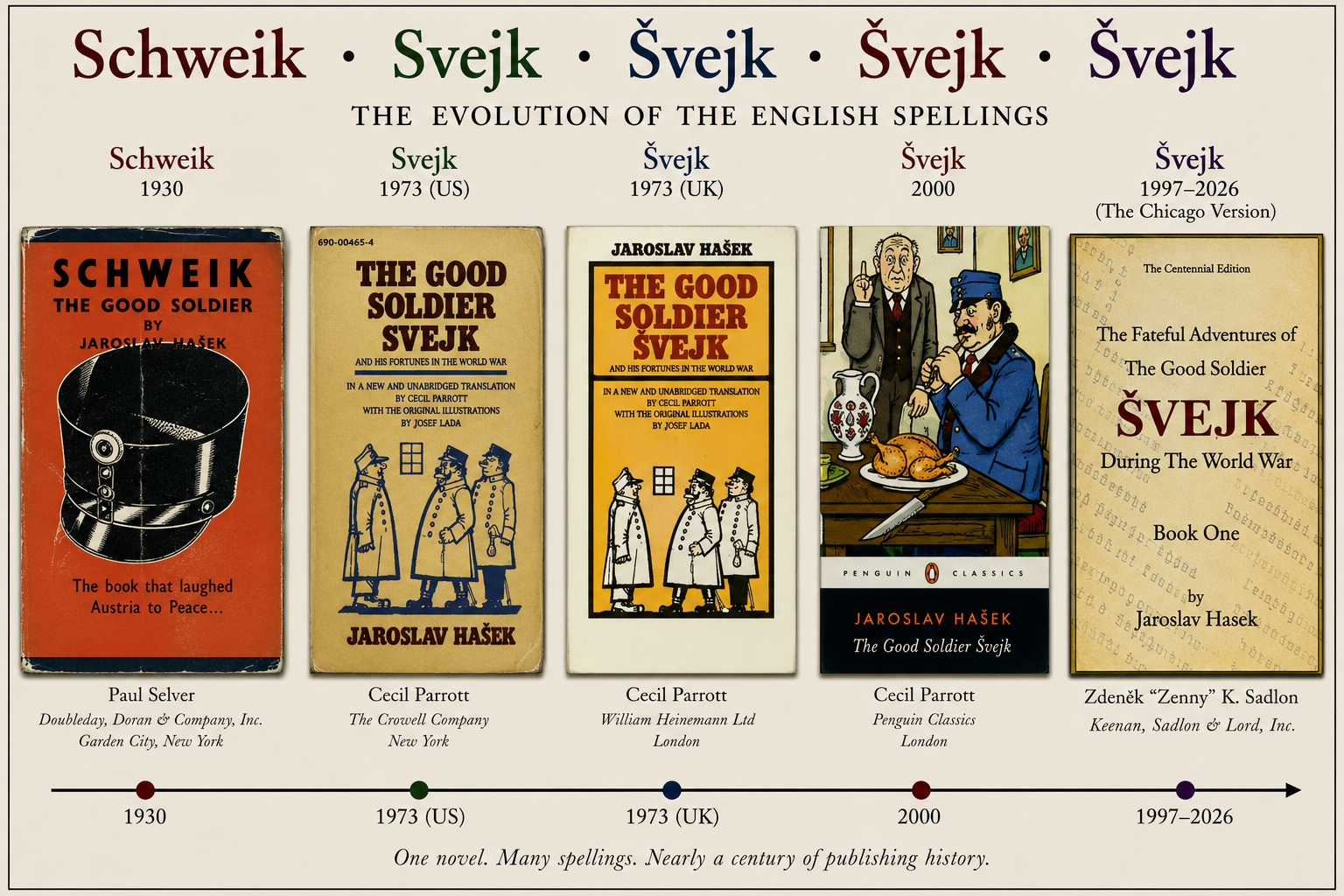
Švejk, Svejk, Schweik, or Schwejk?
Why are there so many spellings?
Anyone searching for Jaroslav Hašek's famous soldier soon encounters an unexpected puzzle. Is his name Švejk, Svejk, Schweik, or Schwejk?
The answer is that all four spellings refer to the same fictional character. They arose through different languages, different publishing traditions, and nearly a century of translation history rather than through differences in the character himself.
Today, all four spellings continue to circulate simultaneously. Readers searching for the novel often encounter different forms in books, films, theatrical productions, library catalogues, scholarly works, and internet searches. Understanding why requires a brief journey through the novel's international history.
The original Czech spelling: Švejk
Jaroslav Hašek named his protagonist Josef Švejk.
In Czech, the letter Š represents the sh sound familiar from English words such as ship. Consequently, the name is pronounced approximately sh-vake (IPA: /ˈʃvɛjk/), with the first syllable beginning with the Czech letter Š.
The original title of the novel is:
Osudy dobrého vojáka Švejka za světové války
literally,
The Fateful Adventures of the Good Soldier Švejk During the World War.
From the standpoint of Czech orthography, Švejk is therefore the correct spelling.
Why "Svejk"?
Outside Czech-speaking countries, the principal obstacle was not pronunciation but typography.
For much of the twentieth century, many English-language publishers, libraries, newspaper archives, cataloguing systems, and early computer databases either could not reproduce Czech diacritical marks or chose not to use them.
The simplest solution was to omit the accent altogether.
Thus:
Švejk → Svejk
This simplified spelling remains common today in URLs, filenames, databases, and search engines where diacritical marks are often inconvenient or unavailable.
Why "Schwejk"?
The spelling Schwejk reflects the novel's early success in the German-speaking world.
Long before Hašek became widely known in English, his novel achieved extraordinary popularity through Grete Reiner's influential 1926 German translation,
Die Abenteuer des braven Soldaten Schwejk.
German represents the sh sound by sch, making Schwejk the natural German spelling.
For many readers outside Czechoslovakia, this German edition became their first encounter with Hašek's work.
Why "Schweik"?
The spelling Schweik entered English through Paul Selver's pioneering 1930 translation.
Although Selver translated directly from Czech, his title,
The Good Soldier Schweik,
preserved the Germanized tradition already familiar to English publishers and readers.
For decades this became the standard English spelling. Numerous reviews, theatrical adaptations, films, library records, and secondary studies adopted Schweik, ensuring that generations of English-speaking readers encountered Hašek's protagonist under that name.
Even today, many websites, older bibliographies, and film databases continue to employ the spelling Schweik.
Why different English editions use different spellings
The history of English translations reflects the changing treatment of Czech orthography in English-language publishing rather than changes in Hašek's novel itself.
The spelling Schweik first entered English through Paul Selver's pioneering 1930 translation:
| Year | Translator | Title |
|---|---|---|
| 1930 | Paul Selver | The Good Soldier Schweik |
| 1973 | Cecil Parrott | The Good Soldier Švejk and His Fortunes in the World War (Heinemann, UK) The Good Soldier Svejk and His Fortunes in the World War (Crowell, US) |
| 1997–2026 | Zdeněk "Zenny" K. Sadlon | The Fateful Adventures of the Good Soldier Švejk During the World War |
Paul Selver's translation introduced the spelling Schweik into English-language publishing. Although the first edition itself reproduces the original Czech title Osudy dobrého vojáka Švejka za světové války with the correct Czech diacritical marks, the English title was nevertheless published as The Good Soldier Schweik. This demonstrates that the Germanized spelling was a conscious editorial choice rather than a consequence of unfamiliarity with the Czech original.
Cecil Parrott's 1973 translation appeared simultaneously in Britain and the United States under slightly different spellings—Švejk in the British Heinemann edition and Svejk in the American Crowell edition. This difference illustrates that spelling conventions were often determined as much by publishing practices and typographical preferences as by the translation itself.
The Centennial Edition consistently preserves the author's original Czech spelling, Švejk.
The history of the English spellings therefore reflects publishing history as much as translation history. Different spellings frequently represent different publishers, markets, cataloguing conventions, and typographical practices rather than different interpretations of Hašek's novel.
1 The 1973 British first edition published by William Heinemann does preserve the Czech caron over the initial Š. On the dust jacket, however, the diacritical mark is rendered so delicately that it is easily overlooked against the bold display lettering. The contemporary American first edition published by Thomas Y. Crowell omitted the caron altogether, printing Svejk. This small typographical difference illustrates the transitional state of English-language publishing at the time: British typography had begun accommodating Czech orthography, albeit cautiously, while American publishing still preferred the simplified form without diacritical marks.
Which spelling is correct?
Strictly speaking, Švejk is the correct spelling because it is the spelling used by Jaroslav Hašek himself.
The others are historical adaptations.
Švejk — original Czech spelling.
Svejk — simplified spelling without Czech diacritics.
Schwejk — German spelling.
Schweik — the first published English spelling, introduced by Paul Selver's 1930 translation.
None refers to a different character.
Why search engines return different spellings
Modern search engines generally recognize that all four spellings refer to the same literary work.
Someone searching for Good Soldier Schweik may receive results for Švejk, while a search for Švejk may produce pages using Schweik or Schwejk.
This reflects the complicated publication history of the novel rather than any uncertainty about Hašek's original spelling.
Why the spelling still matters
One might reasonably ask whether the distinction matters at all. After all, every spelling points to the same fictional soldier.
Historically, however, the evolution of the name illustrates a broader phenomenon that accompanied the novel's international reception.
As Hašek's work crossed linguistic boundaries, publishers naturally adapted spellings to the conventions of their own languages. In German, Schwejk appeared entirely normal. In English, Schweik became familiar through decades of publication. Later, Svejk emerged as a practical compromise when Czech diacritical marks were unavailable.
Each adaptation solved an immediate practical problem.
The question confronting a modern translator is somewhat different.
When the original spelling can easily be reproduced—as it now can in virtually every publishing and digital environment—should one continue reproducing historical approximations, or should one return to the author's own orthography?
The Centennial Edition adopts the latter position.
This decision was not made simply out of typographical preference or national sentiment. It reflects the broader editorial philosophy governing the entire translation.
Throughout the Centennial Edition, the objective has been to preserve Czech linguistic structure wherever English permits rather than replacing it with more familiar English conventions. The restoration of Švejk therefore belongs to the same editorial approach that preserves Czech military terminology, procedural distinctions, recurrent grammatical structures, and culturally specific forms of expression throughout the translation.
The spelling of the protagonist's name thus becomes a small but visible example of a larger principle.
Rather than asking English readers to adapt the novel to English habits, the Centennial Edition invites English to travel a little further toward Czech.
After all, no one today expects Dvořák to become Dvorak, Čapek to become Capek, or Šostakovič to become Schostakowitsch simply because earlier publications once did so. Preserving Švejk follows the same trajectory: it acknowledges the historical variants while returning, whenever possible, to the form chosen by the author himself.